
2026 Budget Speech Highlights
This afternoon, the South African Minister of Finance delivered the highly anticipated 2026 Budget Speech.
Finance Minister Enoch Godongwana presented the 2026 Budget against the backdrop of ongoing fiscal pressure, rising debt-servicing costs, and the need to stimulate economic growth. Unlike the uncertainty that characterised last year’s budget process, this year’s speech focused on stabilisation, targeted inflation relief, and maintaining revenue without introducing major new broad-based taxes.
Early responses from business bodies and market commentators indicate cautious optimism, particularly welcoming the inflationary adjustments to personal income tax brackets and the increased VAT registration threshold, both seen as supportive measures for consumers and small businesses. Concerns remain around fuel-related levies and the broader cost-of-living pressures, but overall, the tone has been more measured and predictable than the previous cycle.
Key Highlights
The 2026 Budget reflects a shift toward stability and incremental reform. The most notable development is the adjustment of personal income tax brackets and rebates to compensate for inflation, a move aimed at protecting taxpayers from “bracket creep.”
In addition, the government continues to support small and growing businesses through an increased VAT registration threshold and turnover tax relief, while maintaining the corporate income tax rate at 27%.
Personal Income Tax Brackets and Relief
In contrast to 2025, personal income tax brackets and rebates have been adjusted for inflation for the 2026/27 tax year (effective 1 March 2026).

Tax Rebates and Tax Thresholds
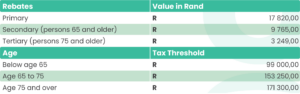
These adjustments provide welcome relief to employees and help preserve disposable income in a constrained economic climate.
Reimbursive Travel Rate
-
No tax payable on reimbursive travel allowances up to R4.95 per kilometre, regardless of vehicle value.
-
Not applicable if other vehicle allowances are received (excluding toll and parking reimbursements).
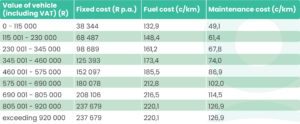
Travel Allowance
Updated SARS per-kilometre cost table applies for 2026/27 (vehicle value bands adjusted accordingly).
What This Means for You
For employers and payroll administrators, the 2026 Budget means:
-
Updated PAYE calculations due to bracket and rebate adjustments.
-
Increased subsistence and reimbursive travel limits.
-
Continued compliance requirements for SDL (1%) and UIF (1% employer / 1% employee).
-
No change to corporate income tax (remains 27%).
For employees, inflation adjustments reduce bracket creep and provide marginal relief.
For small businesses, the higher VAT threshold and turnover tax structure continue to support growth and ease administrative burdens.
High Level Summary (2026/27):
Medical Aid
- Medical Aid Tax Credits increased to:
R376 for each of the first two dependants
R254 for each additional dependent
Subsistence Allowance
- Meals and incidental costs: R595 per day
- Incidental costs only: R184 per day
Companies
- Corporate income tax remains at 27%.
Value-Added Tax (VAT) Adjustments.
There is no change to the VAT rate, which remains at 15%.
Importantly, however, the VAT compulsory registration threshold has increased to R2.3 million per annum, reducing compliance pressure on smaller businesses and supporting entrepreneurship.
The SME sector has positively received this as a practical administrative relief measure.
Other Topical Changes
SARS interest rates (from 1 March 2026): Late or underpayment of tax: 10.25% p.a., Refund of overpayment of provisional tax: 6.25% p.a.
Follow the link below to make use of our updated and easy-to-use PAYE calculator.
Labournet Tax Calculator
Join the FREE webinar:
We’ve partnered with SAPA. Join the FREE webinar unpacking the key highlights from the Budget Speech, with specific focus on Tax, Paternity leave developments, and COIDA updates, and what they mean for employers.
Register your spot here.